


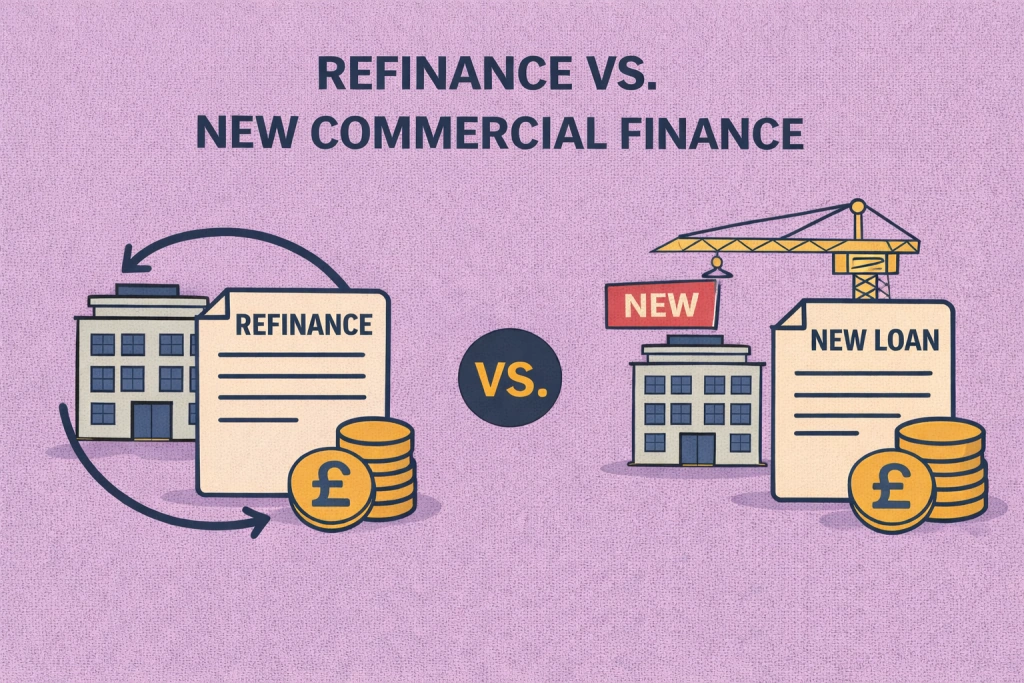
Commercial borrowers often reassess their funding mid-cycle. A facility that worked two or three years ago may no longer align with its current objectives, asset value, or cash flow position.
The decision is rarely just about interest rate. It’s about structure, flexibility and long-term positioning.
Understanding when to refinance an existing facility and when to pursue new commercial finance altogether requires a clear view of what has changed.
Why borrowers reconsider their finance
Refinancing discussions usually arise for one of four reasons.
The asset has increased in value.
Cash flow has strengthened.
The existing facility is restrictive.
The market has shifted.
A rise in asset value may allow equity release. Improved rental income or trading performance may support stronger coverage. Alternatively, borrowers may find themselves constrained by covenants, short residual terms or inflexible repayment conditions.
The trigger matters because it shapes whether refinancing is appropriate or whether a new facility with a different structure is required.

When refinancing an existing facility makes sense
Refinancing is typically appropriate where the core asset and strategy remain the same, but terms can be improved.
Common drivers include:
- Moving from a short-term facility to longer-term debt
- Securing a more competitive rate
- Extending the term to reduce repayment pressure
- Removing restrictive covenants
- Consolidating multiple facilities
Where an asset has stabilised following refurbishment or tenant repositioning, refinancing a longer-term product can reduce the cost of capital and improve cash flow predictability.
Refinancing can also release equity where valuation has increased and coverage remains strong.
However, borrowers should assess whether break costs, exit fees or new arrangement fees offset the anticipated benefits.
When new commercial finance is the better route
In some cases, refinancing is not enough because the underlying objective has shifted.
New commercial finance may be appropriate where:
- The borrower is acquiring additional assets
- The existing lender has limited appetite for expansion
- A different funding structure is required
- Security needs to be restructured across multiple assets
For example, a borrower moving from single-asset ownership to portfolio scaling may require a lender who is comfortable with cross-collateralisation or structured facilities.
Similarly, where capital is needed for expansion rather than simply restructuring existing debt, a new facility tailored to growth objectives may be more appropriate than modifying the current one.
Cost is not the only consideration
It is tempting to approach refinancing decisions through rate comparison alone. This can be misleading.
Key factors include:
- Arrangement and exit fees
- Legal and valuation costs
- Impact on loan-to-value
- Changes in covenants
- Flexibility for early repayment
- Future expansion capacity
A slightly higher rate with greater flexibility may prove more valuable than a marginal rate saving accompanied by restrictive terms.
The structure must support strategy.
Equity release and capital recycling
Where asset value has increased, refinancing can unlock capital.
For instance, if a property was acquired at £1 million with a £600,000 facility and is now valued at £1.3 million, refinancing at a conservative loan-to-value may release additional capital without breaching prudent coverage thresholds.
That capital can be redeployed into new acquisitions or used to reduce higher-cost debt elsewhere.
However, equity release must remain aligned with sustainable coverage. Increasing leverage reduces resilience if income weakens.
Cash flow improvement as a trigger
Refinancing can improve monthly cash flow where:
- The interest rate is reduced
- The term is extended
- Amortisation profile changes
Switching from short-term or interest-only structures to longer-term facilities can stabilise repayment schedules.
Borrowers should model revised coverage ratios after refinancing to ensure that improved cash flow does not come at the expense of flexibility or future capacity.
Market timing considerations
Interest rate environments influence refinancing decisions, but precisely timing markets is usually unpredictable.
Borrowers considering refinancing should assess:
- Current rate environment
- Anticipated rate direction
- Cost of waiting
- Stability of income
In some cases, refinancing to fix rates can reduce uncertainty. In others, flexibility may be prioritised over locking in longer commitments.
Strategic decisions should be based on business objectives rather than short-term rate movements alone.
When doing nothing is the better choice
Not every situation justifies change.
If the existing facility:
- Remains competitively priced
- Aligns with strategy
- Provides adequate flexibility
- Carries minimal restrictive covenants
Then refinancing may introduce unnecessary cost and complexity.
Change for its own sake can erode value through fees and disruption.
A structured review of the current facility against long-term objectives clarifies whether adjustment is required.
A practical decision framework
Before choosing between refinancing and new commercial finance, consider:
- Has asset value or income materially changed?
- Are current terms constraining future plans?
- Will fees and break costs outweigh savings?
- Does the lender’s appetite align with expansion goals?
- Does the revised structure improve resilience?
If the objective is to optimise existing debt, refinancing may be sufficient.
Whether the objective is growth, restructuring, or repositioning, a new commercial facility may provide better alignment.
The right choice depends less on the headline rate and more on the long-term strategic fit.
If you are reviewing your current commercial borrowing and want to assess whether refinancing or a new facility better supports your objectives, Envelop Finance can analyse your existing terms, asset positions, and future plans before approaching lenders.