


Energy Performance Certificates (EPCs) have traditionally been viewed as a compliance requirement for landlords. For many years, EPC ratings were something that needed to be in place to legally let a property, but they did not significantly influence mortgage availability or pricing.
That situation is changing.
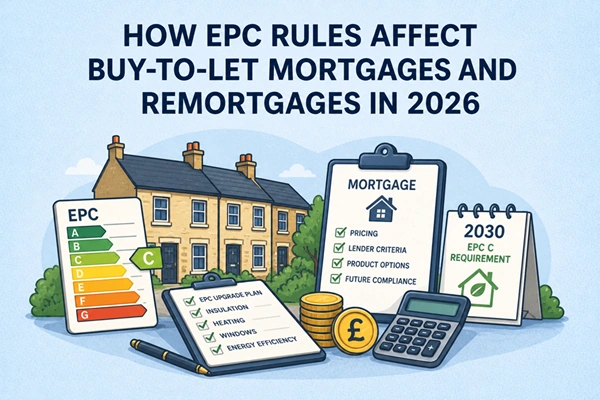
The United Kingdom government has confirmed its intention to require private rented homes to reach EPC C by 1 October 2030, subject to legislation. As a result, EPC ratings are becoming more relevant in lending decisions, particularly around pricing, risk assessment, and long-term planning.
In 2026, EPC ratings can influence mortgage pricing, remortgage strategy, and investment planning. Landlords who plan ahead are generally better positioned as lender criteria evolve over time.
Current EPC requirements for buy-to-let properties
At present, rental properties in England and Wales must meet a minimum EPC rating of E to be legally let. This requirement has been in place since 2020 under the Minimum Energy Efficiency Standards.
Most buy-to-let lenders continue to accept applications for properties rated EPC D and EPC E, and these properties remain mortgageable, including on standard fixed-rate products.
However, EPC ratings are becoming a more visible factor in lending decisions. Lenders are increasingly factoring energy efficiency into pricing and risk assessment.
In practice, this can include:
- Differentiating pricing based on EPC band
- Offering preferential or “green” rates for EPC A to C properties
- Requesting additional information on improvement plans for lower-rated properties in some cases
- Considering long-term property viability as part of broader underwriting assessments
EPC is no longer a simple compliance formality. It is becoming a more visible part of mortgage underwriting, although approaches vary between lenders.
EPC changes and timeline: what landlords should expect from 2026 to 2030
The government intends to require EPC C for private rented homes by 1 October 2030, subject to legislation. While this is not yet law, it is shaping how landlords and lenders think about long-term property suitability.
2026: early market positioning
Although legal requirements have not changed, EPC is becoming more relevant in lending conversations. In 2026, landlords may notice:
- EPC ratings being considered as part of overall affordability and risk assessments
More questions around future upgrade plans for EPC D and EPC E properties - Pricing differences between higher-rated and lower-rated properties becoming more visible
- Increased availability of green or discounted products for EPC A to C properties
This reflects early positioning by lenders rather than a uniform shift in criteria.
2027 to 2029: increasing focus on future compliance
As the proposed 2030 requirement approaches, EPC ratings are likely to become more important in refinancing discussions.
During this period, landlords may see:
- Greater emphasis on EPC ratings when selecting mortgage products
- A wider gap between standard and green mortgage pricing
- More focus on upgrade plans for lower-rated properties
- Lender criteria evolving in response to regulatory direction
Changes are expected to vary between lenders rather than follow a single market-wide pattern.
2030: expected legal enforcement
From 1 October 2030, the government intends that private rented properties will need to meet EPC C or above to continue being let, subject to final legislation and any applicable exemptions.
If implemented as proposed, properties below EPC C may require upgrades in order to remain compliant. This could affect rental strategy, refinancing decisions, and long-term investment planning.
How EPC ratings affect buy-to-let mortgages
EPC ratings can influence mortgage pricing, product availability, and lender positioning, although access to finance remains available across a range of ratings.
Stronger EPC ratings (A to C)
Properties with higher EPC ratings typically benefit from:
- Access to green mortgage products with discounted rates in some cases
- A wider selection of competitive products
- Stronger perceived asset quality
- Greater flexibility at remortgage
Lower EPC ratings (D to E)
Lower-rated properties remain mortgageable, including on standard fixed-rate products.
However, landlords may encounter:
- Fewer opportunities to access green or discounted mortgage products
- Slightly higher rates compared to higher-rated properties
- Additional questions around future upgrade plans
- In some cases, tighter loan-to-value or deposit requirements depending on the lender
It is important to note that this does not represent a blanket restriction. Criteria vary between lenders, and EPC D and E properties continue to form part of the buy-to-let lending market.
Why EPC matters more at the remortgage stage
EPC considerations often become more relevant when a fixed-rate mortgage ends and a landlord needs to refinance.
At this stage, lenders reassess the property against current criteria. A property that previously qualified may:
- Be assessed differently under updated lending policies
- Not qualify for the most competitive pricing
- Prompt discussion around potential improvements
- Result in a different product selection than previously available
For landlords with multiple properties, this can influence overall portfolio strategy.
Example scenario: EPC D remortgage decision
A landlord in Manchester owns a two-bedroom flat rated EPC D. The property performs well from a rental perspective and has a stable tenant.
When the fixed-rate mortgage ends in 2026:
- A range of lenders still offer suitable mortgage products
- Pricing may be slightly higher than for comparable EPC C properties
- Some lenders may ask about plans to improve the EPC rating
- Green or discounted products are less likely to be available
The landlord’s options could include:
- Remortgaging on a standard product at current market rates
- Upgrading the property to EPC C to access a wider product range
- Choosing a shorter-term product while planning improvements
- Using short-term finance to complete upgrades before refinancing
This type of decision is becoming more common as EPC considerations become more visible in lending discussions.
EPC upgrade costs and mortgage impact
Improving an EPC rating typically involves insulation upgrades, heating system improvements, glazing, or the addition of energy-efficient controls.
Typical cost considerations
Moving from EPC D to EPC C varies depending on the property, but may involve:
- Around £1,500 to £5,000 for lighter improvements
- £5,000 to £12,000 or more for more extensive upgrades
Why upgrades matter financially
Improving an EPC rating can:
- Increase access to a broader range of lenders
- Improve eligibility for green mortgage products
- Support more competitive pricing
- Strengthen long-term investment viability
- Reduce regulatory risk over time
In some cases, improved financing terms may offset part of the upgrade cost.
Strategic approach: EPC as part of mortgage planning
EPC should now be considered as part of a broader financial strategy rather than a standalone compliance issue.
A structured approach may include:
- Reviewing EPC ratings across a portfolio
- Aligning remortgage timelines with upgrade plans
- Budgeting for improvements ahead of 2030
- Prioritising lower-rated properties
- Factoring energy efficiency into long-term returns
Planning ahead reduces pressure at the point of refinancing and supports more flexible decision-making.
How specialist mortgage advice helps
As lender approaches vary, working with a specialist broker can help landlords navigate EPC-related considerations more effectively.
Support may include:
- Identifying lenders with suitable criteria for different EPC ratings
- Structuring refinancing around future upgrade plans
- Advising on whether improvements should be completed before remortgage
- Exploring short-term finance where appropriate
- Aligning mortgage strategy with longer-term regulatory expectations
Conclusion: EPC is becoming part of lending decisions
EPC ratings are playing a more visible role in buy-to-let lending, particularly in relation to pricing, product selection, and long-term planning.
While EPC D and E properties remain mortgageable, landlords may find that higher-rated properties offer access to a broader range of products and more competitive terms.
With the proposed 2030 requirement approaching, landlords who plan ahead and factor EPC into their strategy are better positioned to manage refinancing decisions and maintain flexibility over time.